
Harmony Commons at the University of Toronto Scarborough

Scarborough, Ontario

The largest Passive House certified building in Canada and the largest Passive House certified student residence in the world
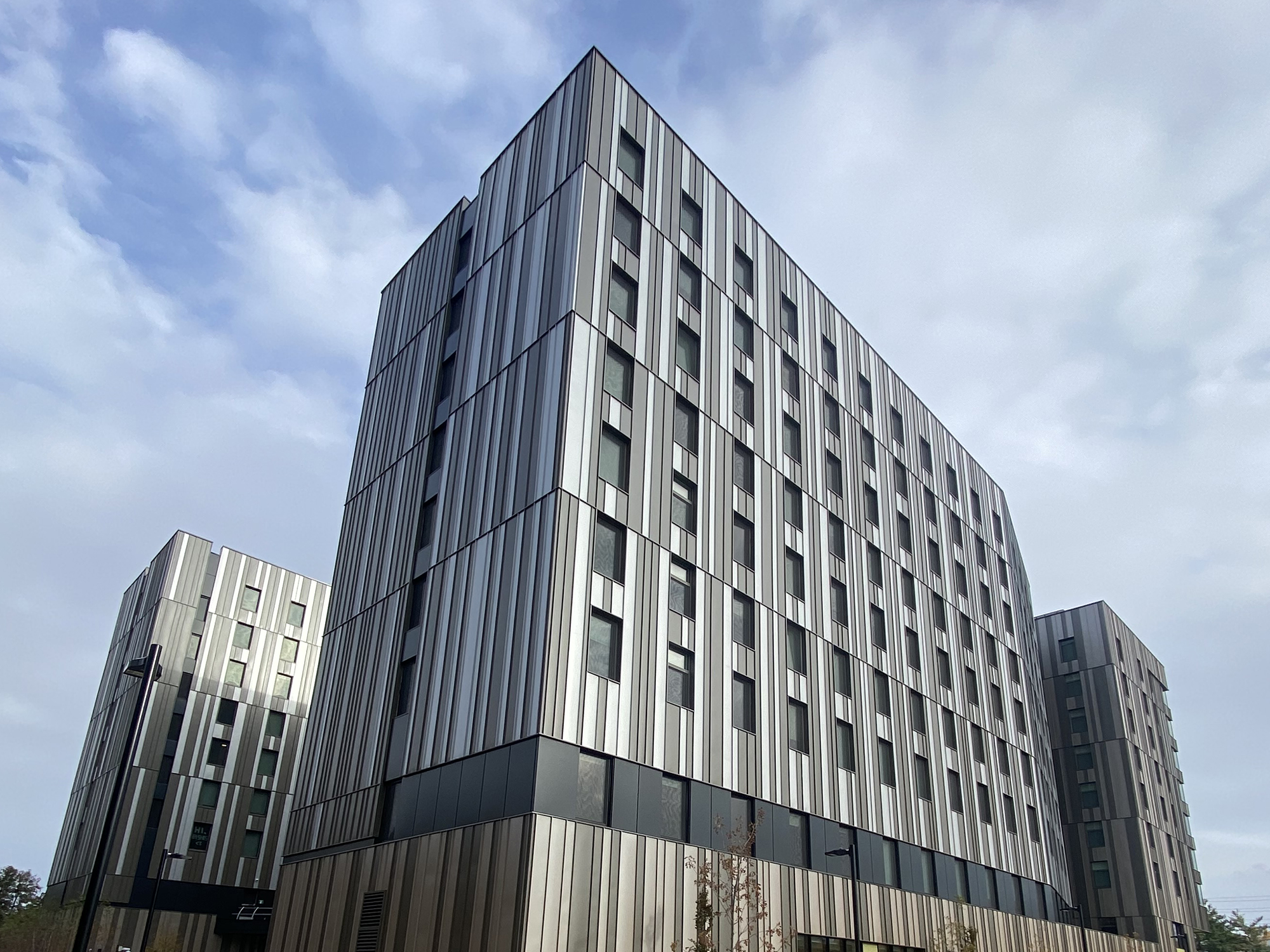
Exterior view of Harmony Commons student residence at the University of Toronto, featuring two modern mid-rise buildings with vertically striped metal cladding and rows of rectangular windows.


Harmony Commons is a 752-bed student residence at the University of Toronto Scarborough campus. The university had the ambitious goal to design this dormitory to the Passive House standard, making it one of the largest certified student housing projects in North America. The project sets a new precedent for how buildings of this typology and scale can meet the demands of both performance-based design and policy-driven climate goals in Canada.

Canada’s climate framework—aiming for net-zero-ready buildings by 2030—has increased demand for high-performance standards. Harmony Commons aligns with the Toronto Green Standard Tier 2, provincial energy codes, and the City of Toronto’s Zero Emissions Buildings Framework, making it a practical demonstration of how Passive House strategies can meet (and exceed) these benchmarks.

SWA collaborated closely with the design and construction teams throughout the project to ensure that all Passive House were met without compromising functionality or delaying the schedule. Harmony Commons stands as a highly energy-efficient, low-carbon building that will provide long-term operational savings as well as superior indoor air quality and thermal comfort for student residents.

Project Team

  • Developer & Owner: University of Toronto
  • Architect: CORE Architects Inc., Handel Architects LLP
  • Mechanical Engineer: Integral Engineering

Building Details

  • 752-bed student housing
  • 274,000 SF, 8 stories
  • Designed with three distinct wings to help cluster students and facilitate community
  • Commercial kitchen, cafeteria, offices, and student life spaces on ground floor

SWA Services

  • Energy modeling
  • Field verification
  • Passive House consulting

Learn more >>

Certifications

Passive House Institute logo

Passive House Institute (PHI) Classic

Design Strategies


Applying the Passive House standard at scale

  • High-performance envelope with continuous insulation and minimized thermal bridging
  • Balanced mechanical ventilation with energy recovery to maintain air quality and thermal comfort
  • Optimized glazing and shading to manage solar gains and reduce cooling loads
  • Rigorous air-sealing to achieve Passive House airtightness levels
  • Variable refrigerant flow (VRF) heating and cooling system
  • All-electric commercial kitchen equipment
  • Commercial kitchen ventilation design with exhaust air heat recovery and demand controls

Note: Commercial kitchens have a high predicted annual energy demand, requiring the selection of the most efficient cooking equipment to align with the energy goals of Passive House.